Monday, October 23, 2023

Tulle Dish Scrubber - Super Easy Crochet

 Tulle Dish Scrubber - Super Easy Crocheted Pattern


This is an easy project and the scrubbers work great. They can be used on teflon/non-stick pans safely.

The scrubbers are made with 6" tulle. Spools of this tulle can be purchased many places, including big box stores or many crafting stores. You can also buy tulle by the yard and cut into 6" widths but the spools have tulle long enough to make scrubbers without having to join sections of fabric.

Appendix

Sl st - slip stitch
HDC - half double crochet
DC - double crochet

1 spool 6" tulle
1 J crochet hook

Chain 6, slip stitch into first chain to join.

1 ch, 12 HDC around chain circle.

Slip st into first HDC to join.

2 ch, 2 DC into each HDC, slip st into first DC to join. (24 st)

Cut. No need to leave long tail. Leave about 1-2" tail.

Now repeat for second half. This time don't cut.

Put two halves wrong sides together and slip st around perimeter of both halves to join.

Saturday, September 9, 2023

Winter Chunky Headband with Ears (or without Ears) - Free Pattern


Winter Chunky Headband with Ears (or without Ears)

1 skein Chunky [6] yarn

Scrap yarn for ear lining Chunky [6]

Size 15 knitting needles

Tapestry needle with hole large enough for chunky yarn

Size N crochet hook


Gauge 2 st/1” and 4 rows/1” measured in moss stitch pattern


CO 5


Two Cast On options


Option 1: Long tail cast on and bind off end then use mattress stitch to sew ends together.

Option 2: Provisional cast on and use Kitchener’s stitch to attach starting row to ending row.


I’ve used the crocheted provisional cast on for this project. Use a similar weight, smooth, different colored yarn. Crochet two chain stitches then use crochet hook to pull yarn over knitting needle and pull through loop until you have 5 stitches. Crochet two more chain stitches off the needle then leave a large loop at the end to identify which end to pull when you are ready to remove provisional stitches. These stitches don’t count anywhere. They only exist to hold the first row’s stitches live.


The benefit of starting with a provisional cast on and then using Kitchener’s stitch to graft the two ends together is a smooth, invisible join that has nice stretchability. If you aren’t ready to do this process then just cast on as normal and bind off as normal and sew the two ends together. The join will barely be noticed since it’s at the back of the head.


Start knitting with main yarn.

Row 1: Knit 5

Row 2: Purl 5

Row 3: Knit 5

Row 4: Purl 5

Row 5: sl 1, KFB, K1, KFB, K1

Row 6: sl 1 wyf, P6

Row 7: sl 1, KFB, K3, KFB, K1

Row 8: sl 2 wyf, K1, P1, K1, P1, K1, P1, K1, P2

Row 9: sl 2, K1, P1, K1, P1, K1, P1, K3

Repeat rows 8 and 9. The two slipped stitches at start of each row will form an icord edge.  Be sure to bring the yarn forward when slipping the first two stitches on the wrong side of the work (even numbered rows). It won’t take long to see the pattern forming. It is a moss stitch with an icord edge.


Work until piece measures 2” less than desired head circumference.

In general, for baby work to 15”, for toddler work to 16”, for child work to 17”, and for adult work to 18”.


RS Row 1x: sl2, K1, sl 2 knitwise together, K1, pass both slipped sts over last knit st, K3

WS Row 2x: sl 2 wyf, K1, P1, K1, P2

RS Row 3x:  sl 2, K1, P1, K3

WS Row 4x:  sl 2 wyf, K1, P1, K1, P2

RS Row 5x: sl 1, K1, sl 2 knitwise together, K1, pass both slipped sts over last knit st, K2

WS Row 6x: sl 1 wyf, P4

RS Row 7x: sl 1, K4


If you used long-tailed cast on, bind off and join two ends with mattress stitch.


If you used provisional cast on, remove scrap yarn and insert live stitches onto other needle.  There will be five stitches on each needle for a total of ten stitches. Needle 1 will be front needle and Needle 2 will be back needle.


Kitchener’s Stitch:

First, prepare for Kitchener’s stitch by sliding tapestry needle purlwise into first stitch on needle 1 then knitwise into first stitch on needle two.  Be careful to keep the working yarn from sneaking up over the needles as you work.


Now we begin:

Insert tapestry needle knitwise into first stitch on Needle 1 and push it off Needle 1 then insert tapestry needle into second stitch purlwise.


Now insert tapestry needle into first stitch purlwise on Needle 2 and push it off Needle 2 then into second stitch purlwise.


Let’s go back to needle 1 and insert tapestry needle knitwise into stitch 2 and push it off needle 1 then purlwise into stitch 3. Now needle 2’s turn. Insert tapestry needle purlwise into stitch 2 and push it off needle 2 then knitwise into stitch 3. Do the same for stitch 4 and 5 and that’s it. Weave in yarn end and cut off.


See the pattern? For stockinette stitch there’s an easy mantra I recite, “knit off purl then purl off knit”. It’s technically knitwise and purlwise but saying “knit off purl then purl off knit” kept it straight for me. The closest needle, Needle 1 will always be knit off purl and the farthest needle, Needle 2, will always be purl off knit for stockinette stitch joins.


Ears (Crocheted version)

Make 2 in main color

Make 2 in contrasting color


In magic loop, 5 hdc, slip to join (5)

2 hdc in each hdc (10)

*2 hdc in same stitch, 1 hdc, repeat from * (15)


Using main color, crochet together a back ear piece and lining ear piece with single crochet. Leave a tail about 12-16” to sew to headband.


Ears (Knit version)

Make 2 in main color

Make 2 in contrasting color


CO 2


KFB x2

K1, KFB x2, K1

K2, KFB x2, K2

K3, KFB x2, K3

K4, KFB x2, K4


Bind off, leaving 1 stitch on needle. Turn ear and pick up 1 stitch in center of bottom of ear and 1 stitch at other end of bottom of ear, bind off these three stitches. This is to complete the shaping of the ear but if picking up stitches is intimidating you could use yarn tail and tapestry needle and gather up bottom by stitching into center and far end of bottom of each ear back and ear lining.


Crochet back of ear and lining together using main color yarn and single crochet stitch. Or whipstitch for those not knowing how to crochet.


Attaching ear:

Fold headband in half with seam in center. Sew ears onto headband third row from the front about 1” from each side. Tack tip of ear to get a more pointed ear. To tack ear tip, after sewing on ear run yarn up back of ear between back and lining. About 1-2 stitches down from top of ear run yarn in and out from side to side about 4x then secure by weaving yarn tail a few times in the back of the ear. For rounded ear don’t tack tip of ear.


I used Lion Brand Hometown chunky for most headbands and Wool Ease for the white and gray multi-colored headband.


Legend

CO = cast on

K = knit

P = purl

Sl = slip stitch. Insert needle as if to purl but with yarn in back (unless otherwise noted with wyf) and slip stitch from left needle to right needle without working it.

KFB = knit into stitch then knit into stitch again but through back before finishing stitch by releasing from left needle.

Wyf = with yarn in front

Wyb = with yarn in back

RS = right side

WS = wrong side

Icord = knitting stitches on a straight needle but never turning work and always working from right side, which causes yarn stretched across back of work to pull work into a tube shape.

Hdc = half double crochet

SC = single crochet

Friday, September 1, 2023

Crocheted Addy Bear


Crocheted Addy Bear - Free Pattern


Designed and created by Robyn for Cosmic Pony.

1 skein (3 oz) medium weight yarn

1 G hook

1 tapestry needle

1 embroidery needle

Embroidery floss: brown (or choice) for nose, white or ivory for highlight, and choice for eye color.


Medium Skill Level


Gauge: with G hook is 4 st/inch


Terms:

Incr= 2 sc in same stitch

Decr= insert hook into stitch, do not pull through loop, insert hook into second stitch, pull through all three loops on hook

sl= insert hook into a stitch and pull into loop on hook without doing a yarn over

(#)= how many stitches in that Row

Stitches within * are a set to be repeated as many times as noted. Example, 1 sc *2 sc, incr* 2 times, 2 sc… would result in 9 stitches because you would do 1 sc and then do 2 sc and an increase and then a second time you would do 2 sc and an increase then finish with 2 more sc.


Work is done in Rows but not turning. At the end of each Row, slip stitch to first stitch of current row to finish row. Each ch 1 starting the new Row will bump up to next row and count as first stitch. Every ch1 is included in stitch count for row in parentheses (). Slip stitch is never counted as a stitch.


Leave about 12”-16” tail of yarn on body, one ear, the muzzle, one arm, and one leg for attaching together. Example, it’s not necessary to leave yarn tail on head piece because yarn tail on body piece will be used to sew the two together. Weave in tails on pieces without required longer yarn tail.


At the end of every row, slip stitch to first stitch of current row then do the ch1 which starts each row.


Body

Row 1: ch3, slip stitch, ch1, 5 sc inside loop  (6)

Row 2: ch 1, sc in same stitch as ch1, 2 sc in each stitch across  (12)

Row 3: ch 1, incr, *1 sc, incr* 5 times  (18)

Row 4: ch 1, incr, *1 sc, incr* 8 times, 1 sc (28)

Row 5: ch1, 27 sc in back loop of stitch (28)

Row 6: ch1, 27 sc (28)

Row 7: ch1, 8 sc, incr, *2 sc, incr* 3 times 9 sc (32)

Row 8: ch1, 31 sc (32)

Row 9: ch1, 9 sc, decr, 8 sc, decr, 10 sc (30)

Row 10: ch1, 29 sc (30)

Row 11: ch1, 13 sc, decr, 14 sec (29)

Row 12: ch1, 9 sc, decr, 5 sc, decr, 10 sc (27)

Row 13: ch1, 26 sc (27)

Row 14: ch1, *5 sc, decr* 3 times, 5 sc (24)

Row 15: ch1, 23 sc (24)

Row 16: ch1, 5 sc, decr, *2 sc, decr,*2 times, 6 sc (19)

Row 17: ch1, 2 sc, decr, *2 sc, decr,* 3 times, 2 sc (15)

Add stuffing

Row 18: ch1, decr, *2 sc, decr,*3  times  (11)

Row 19: ch1, 6 decr, (7) tie off, leaving about 12” tail of yarn


Head

Row 1: ch3, slip stitch, ch1, 7 sc inside loop (8)

Row 2: ch1, sc in same st as ch1, 2 sc in each stitch across (16)

Row 3: ch1, incr, *1 sc, incr* 7 times (24)

Row 4-8: ch 1, 23 sc (24)

Row 9: ch1, decr, *1 sc, decr* 7 times (16)

Row 10: ch1, 7 decr, tie off, weave in end.


Ears (Make 2)

Row 1: ch5, 1 sc, incr, incr, 1 sc (6) ch 1, turn

Row 2: 1 sc, incr, 1 sc, (10) slip stitch to last stitch of foundation chain ch1, turn

Row 3: 10 sc, (10) slip stitch to first ch st

Note: to give ears nice Rounded shape, slip stitching last stitch in Row 2 and Row 3 will pull edges down nicely.

To sew on both ears with one strand, leave yarn tail at least 12" on one ear for sewing onto head and weave in end of other.


Muzzle

Row 1: Ch 5, sc into 4th ch stitch, 2 sc, 5 sc in 1st ch stich

Row 2: 3 sc bottom of chain, sl st

Row 3: Ch1, 11 sc outside loop of stitch

Row 4: 11 sc, slip stitch, tie off with yarn trail for sewing.

Use a small bit of stuffing.


Attach Ears and Muzzle to Head before attaching Head to Body.

Ears go halfway on head, top about 2nd row from top.

Use yarn tail to whip stitch ears into place.

Muzzle goes in center in bottom half of head.

Use yarn tail to whip stich muzzle into place.


Attach Head to Body.

Be aware of body’s belly curve when attaching head to body.  Attach head so that belly is aligned with head, both facing in the same direction.


Legs (Make 2)

Row 1: ch3, sl st, ch1, 7sc, sl st (8)

Row 2: ch1, sc in same stitch as ch1, 7 incr (16)

Row 3: ch1, incr, *1 sc, incr* 7 times (24)

Row 4: ch1, 23 sc in back loop of stitch (24)

Row 5-7: ch1, 23 sc (24)

Row 8: ch1, sc, decr, *2 sc, decr* 5 times (18)

Row 9: ch1, 17 sc (18)

Row 10: ch1, 2 sc, decr, *2 sc, decr* 3 times, 1 sc (14)

Row 11-15: ch1, 13 sc (14)

Row 16: ch1, 1 sc, decr, *2 sc, decr* 2 times, 2 sc (11)

Row 17: ch1, 10 sc (11)

Row 18: ch1, 1 sc, decr, *1 sc, decr* 2 times, 1 sc (8)

Row 19: ch1, 3 decr, 1 sc (5)

Leave 12”-18” yarn tail on one.


Arms (make 2)

Row 1: ch3, sl, ch1, 5 sc inside loop, sl stitch (6)

Row 2: ch1, sc in same st as ch1, 5 incr (12)

Row 3: ch1, incr, *1 sc, incr* 5 times, 1 sc (19)

Row 4: ch1, 18 sc in back loop only of stitch (19)

Row 5-7: ch1, 18 sc (19)

Row 8: ch1, 9 decr, (10)

Row 9: ch1, 9 sc (10)

Add some stuffing

Row 10-15: ch1, 9 sc (10)

Row 16: ch1, 5 decr, tie off

Leave 12”-16” yarn tail on one arm and weave in end on other arm.


Attach arms and legs to body. Using yarn tails, place arm on body shoulder, roughly lining up to ear placement above. Since this is for a child’s toy I tie one or two extra knots to make it secure, choosing a place such as under appendage and further hiding knots between stitches. Legs get attached in line with arms, at row or two above body’s fifth row.

Note: you can either whipstitch around top few rows of arms or once yarn is secured to arm run needle back and forth through body and the two arms at least eight times and finish off. It’s treating the arm like a button. Running the yarn back and forth allows arms to pivot. Do the same to attach the legs.


Embroider.

Use satin stitch and all 6 strands of floss. Don’t worry about exact placement as differences give them uniqueness and personality. Because of the structure of the crocheted stitches it’s pretty much impossible to get a circle so satin stich as close to a circular shape as possible. Use photo for reference.

Eyes go just above muzzle and to either side of muzzle. Each eye gets one French Knot for a white highlight.

Nose, make a triangle at top of muzzle or give bear a big honker like red bear.

The mouth is formed by running a long stitch from bottom of nose to edge of muzzle, back up to nose and then down to edge of muzzle on other side and back up to bottom of nose to finish off.


1 skein of Lion Brand Tweed Stripes (3 oz) was used for each brown or red bear.

2 skeins of Sensations Beautiful  (1 ½ oz) is required for white bear but there will be some left over.


Thursday, August 24, 2023

Kichener's Stitch

Kitchener’s Stitch

Needle 1 will be front needle and Needle 2 will be back needle.


First, prepare for Kitchener’s stitch by sliding tapestry needle purlwise into first stitch on needle 1 then knitwise into first stitch on needle two.  Be careful to keep the working yarn from sneaking up over the needles as you work. Now we begin.


Insert tapestry needle knitwise into first stitch on Needle 1 and push it off Needle 1 then insert tapestry needle into second stitch purlwise.


Now insert tapestry needle into first stitch purlwise on Needle 2 and push it off Needle 2 then into second stitch purlwise.


Let’s go back to needle 1 and insert tapestry needle knitwise into stitch 2 and push it off needle 1 then purlwise into stitch 3. Now needle 2’s turn. Insert tapestry needle purlwise into stitch 2 and push it off needle 2 then knitwise into stitch 3.


See the pattern? For stockinette stitch there’s an easy mantra I recite, “knit off purl then purl off knit”. It’s technically knitwise and purlwise but saying “knit off purl then purl off knit” kept it straight for me. The closest needle, Needle 1 will always be knit off purl and the farthest needle, Needle 2, will always be purl off knit for stockinette stitch joins.


Wednesday, May 13, 2020

How to Make a Bowl Cozy with Tips, Hints, and Helpful Suggestions

Bowl Cozy Tips and Suggestions


I decided to make some bowl cozies a few months ago. Where have they been all my life, right? I mean, who hasn't resorted to wrapping a kitchen towel around a hot or cold bowl while heading for the couch to watch a favorite show on tv?


Ice cream is the worse. I don't know about you but I don't always think about grabbing a towel or crocheted trivet when filling a bowl of ice cream for a treat while watching a show and that bowl gets really cold.

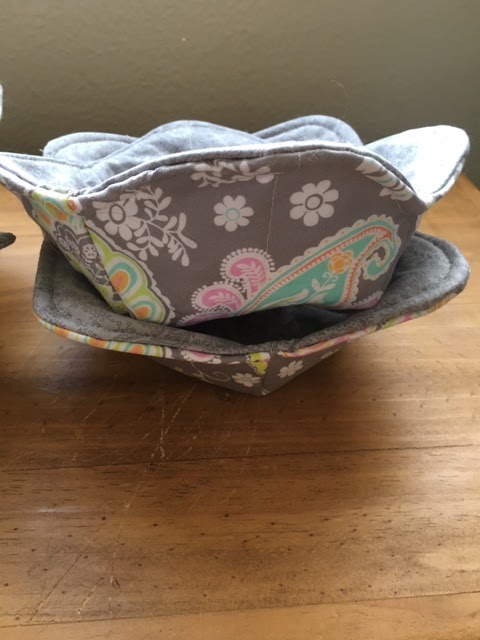
So I made some lovely bowl cozies. LOVE them! There are a lot of videos out there on how to make a bowl cozy. This is more of little hints and suggestions for things I encountered while making them that were not really addressed in the videos that I watched prior to taking on this project.

First, there were videos that showed to use 9" squares of fabric or 10" squares of fabric. I went with the 10" squares. It's a nice size for most bowls. I do have a few tall bowls that the 9" would give a more snug fit but 9" would not work for the Pyrex bowls that I put leftovers in for warm up.

If you want, you could make some 9" bowl cozies and some 10" bowl cozies but if you want to cover a mystery size, as in a gift for someone who's bowls you are not intimately familiar with their size and shape, I recommend the 10" size.

Really, any square size will do. So 8", 9", 10", 9.5".....just as long as they are square. But 9" or 10" is the most common size used for tableware. You might want to make one for serving dishes and go up to 11" or 12" squares.

So, for each cozy we have a 10" square of outer fabric, 10" square of inner fabric, and 2 10" squares of batting. The cozies are reversible when finished so I will refer to inner and outer instead of outer and lining.

The first step will be to place a piece of batting and outer piece together with wrong side facing the batting and sew an X through the middle of the piece. Start at one corner and sew to the opposite corner then repeat for the other two corners. Now do the same for the second piece of batting and the inner fabric. This X is to hold the fabric and batting together.

If you wanted to do more quilting, that could be fun. Not necessary but fun. Some type of twirl in the bottom of the cozy would be nifty. But, there will be darts made and fabric cut, so I would wait on getting elaborate with the quilting and stick with the basic X for the first ones you do.

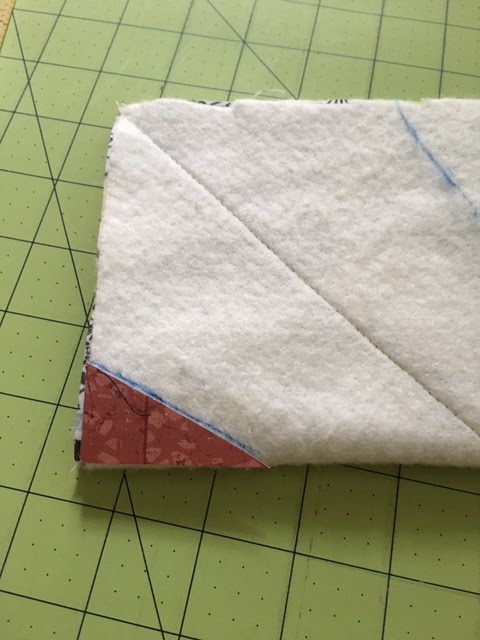
All right, so we have batting secured to both the inner and outer squares. Now we make the darts. In all the videos I watched they folded the square in half and measured 1" up from the corner and 2" over then drew a diagonal line between the marks. After the first two are marked, fold the other side and mark those corners. Now do that for the other piece.

Whew! That's a lot of tedious measuring and marking and lining up rulers. So each cozy has 8 darts. I am going out on a limb here but am pretty sure that you will be making more than one cozy. Even if you live alone and don't have to squabble over the single bowl cozy, you'll still want one available when the first one is in the wash after you dribbled chili all over it. Lots of left over chili to need to eat while snuggled in the cozy.

That means a minimum of two cozies. But if you have a family you'll need to make 5 or 6 or 10 or 12 and  I suspect you'll be making them as gifts. So if you make 5 cozies for a family of 5 that's 40 darts. Sounds like a lot, right? That's where a template comes in.


Tip #1: Make a dart template.
Mark 1" and 2" on a piece of paper, card stock, cardboard, or whatever is at hand and draw a diagonal line between marks and cut. I used a scrap piece of card stock.


You'll notice that it's directional. Don't worry. Just flip it over to mark the other side. Now sew along the diagonal line. In the video they said to sew along the diagonal line then trim off excess fabric along the dart. WAIT!


Tip #2: Walk the edges before cutting the darts.

The first batch of cozies that I made was a set of 4. On one dart I was slightly off and that meant that when I checked to make sure that the corners of the inner piece and outer piece matched, they did not. The corner was short over 1/2", too far to ease in or anything and would have really resulted in a messed up cozy.

 It was a simple fix to rip out the dart and remark and resew because I had not trimmed off the dart's excess fabric. Once I was certain that everything matched up, then I trimmed about 1/8" or so from dart seam.


Now we're nearing the end. Did you notice that some of the cozies have pointed corners and some have rounded corners? I like them the best. They look pretty, like a flower and have a lower profile for the bowl. If you want the round corners, just round the corners by finding something round and marking.


Tip #3: Use something round to help round the corners.
I used the bottom of a candlestick holder. You can use a small bowl, a jar lid, or punch out a circle from cardboard or card stock. The goal is just to round the tip off the corner.


Place the two pieces with inner and outer fabric right side together. Mark the corners and trim off the tip of the corner.


Now sew around the perimeter, leaving a 2-3" gap for turning. Pick the straightest spot you can find. The 2" is a snug fit but will still work but if it's too difficult go with 3" gap. It's a lot like giving birth in respect to thinking it's not possibly to get all that fabric and batting through that small space but it will work.

Turn right side out, use finger, chop stick, or something to smooth out corners then sew gap closed while topstitching around.

Done!


Friday, April 10, 2020

Olson Mask Style with Some Tweaks and Speedy Tips and Pattern

During these crazy times of COVID-19 and the social distancing, isolation, and mask wearing, I have been in the crowd of making lots and lots of masks for friends, family, and medical personnel. The most popular style is the deacon mask because even a novice sewer can do those. But the Olson mask is also easy to sew and preferred by many medical personnel.


I started with the Olson mask from here: Olson mask pattern A
From Instructable Crafts

Then I made some changes as a result of watching a video of a hospital who was requesting masks and specifically Olson mask style. I eliminated an extra step and as a quilter used the chain stitching method to speed things up.

Keep in mind that this is all new. Most of us had never sewn a clothe face mask before two or three weeks ago. There is a learning curve and as people learn best methods things change.

This is my method. I can actually sew them up faster than the deacon style (pleated rectangles) but cutting is a bit slower though not bad.

Steps:
First, print 3 copies of Pattern A.

Cut out patterns pieces.


1st piece will be used as is. This will be the outer face of the face mask.

With 2nd piece, cut vertically 4 1/2" from right side edge. This will be the side pieces of lining.

With 3rd piece, cut vertically 2" from right side edge. This will be the pocket piece of lining.


You can clip points of side lining pattern to eliminate the little dog ears.


Cut 2 pieces of quilting cotton or other cotton fabric that will hold up to washing for the outer face.

Cut 2 pieces of flannel or cotton fabric for side pieces.

Cut 2 pieces of flannel or cotton fabric for pocket piece.

Clip or mark tops of mask pieces if necessary. I recommend this for the first few for sure. The top has a sharper rise and point. It matters most when placing outer piece to lining pocket piece. If tops don't match it won't work. If top of side lining pieces don't match it will still sort of work but the overlap will shrink.

The edges where we cut the pattern piece need to be finished as they will be left exposed. To finish the edge I fold under about 1/8" and fold over again so that edge is completely encased when I sew the seam along the edge of the fold but you can fold over 1/4" and either zig zag or use pinking shears to keep the edge from fraying.


I do the chaining method of sewing whenever possible. It saves time and thread. If you want to do the chain sewing this is the order I sew each mask so that I don't have to raise the needle for the whole mask.

Sew the curved seam of the lining pocket.


Sew the inner edge of a side piece.


Sew the edge of the lining pocket piece.


Sew the inner edge of a side piece.


Sew the second edge of the lining pocket piece.

Sew the curved seam of the two front facing pieces.


That was all done without having to raise the needle.

I trim both curved pieces with pinking shears. You can clip if you don't have pinking shears.


Now place right sides together of front facing and lining pocket, matching seams. I stick a pin here to hold it in place.


Now position a side lining piece with its matching front facing position.
You can pin all the pieces in place if you want but I don't. The flannel clings to the outer piece quite nicely and stays put but some people like to pin, especially when starting.


The side lining piece and pocket lining piece overlap.


Sew around perimeter of mask. Back tack a few stitches (2-3) whenever you reach a finished seam edge to help strengthen the spots where there will be a lot of pressure if people need to insert/remove some filter. When you reach seams, to avoid bulk, make seams face in opposite directions. Continue just past seam then lining up second side lining piece in its proper position and continue sewing.


Clip tops of curved seams, being careful not to cut through stitching. 4 places to clip.


Turn right side out through pocket.

To make casing for nose wire, start sewing about 1" before seam and stop about 1" after seam, 1/4"-5/8" from edge, being sure to back tack at start and end. I cut the wire about 4" and curve the ends. After inserting wire into casing through pocket, I bend wire ends down. This helps keep it positioned in the casing.

If the wire resists going through casing try going through on other side.

To attach pony tail holders, bias tape, or elastic...

I use pony tail holders. The most stretchy I can find, which so far has been Scrunchi.
If you have elastic, cut about 7-8" and overlap ends about 1/2" and sew shut, forming a loop.
If you are using bias tape, you will need two strips of 40", one for each side.

Insert ends of mask through elastic loop, fold over, and sew along edge. I try to keep casing to 1/4" or as close as possible. Be sure to back tack at start and end as there will be a lot of pressure on the casing ends.


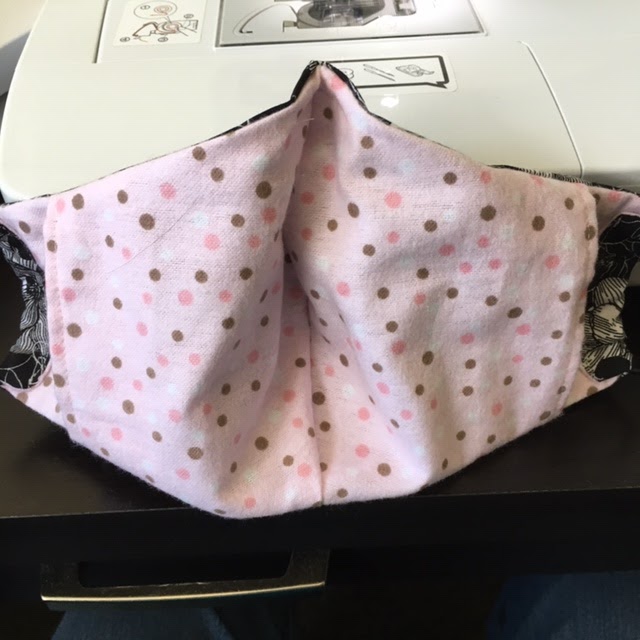
There is a lovely finished Olson style mask with nose wire.


 I hope you find this helpful. Remember, we are all new at this and as we learn we tweak and improve the best we can.

I have made over 100 masks so far (and still going), some deacon and some Olson style. I actually prefer the Olson style, both to wear and making it. It's maybe a personal choice and I'm not sure why I like the look so much better. I think it's because the deacon style looks like a medical mask whereas the Olson style looks like a post-apocalyptic fashion statement. :)

What I do know is that a lot of people have dusted off their sewing machines, cracked open bins of fabric stashes, and burnt the midnight oil making all sorts of masks for family, friends, and medical personnel. For our community.

I hope you find this a faster, stream lined version and if I helped anyone at all with this, then it was worth the time to map out the steps.


Sunday, March 22, 2020

Quilted Fabric Coasters

Pieced Quilted Fabric Coasters


With the two big cross country moves the past two years I misplaced my lovely fabric coasters. Oh, they are somewhere. Most likely they are in a box in the storage unit that ended up being used far longer than I anticipated. So it felt like quite the score when I found six front pieces and a dozen flannel pieces cut and ready to be made into coasters once I cut the backing pieces.

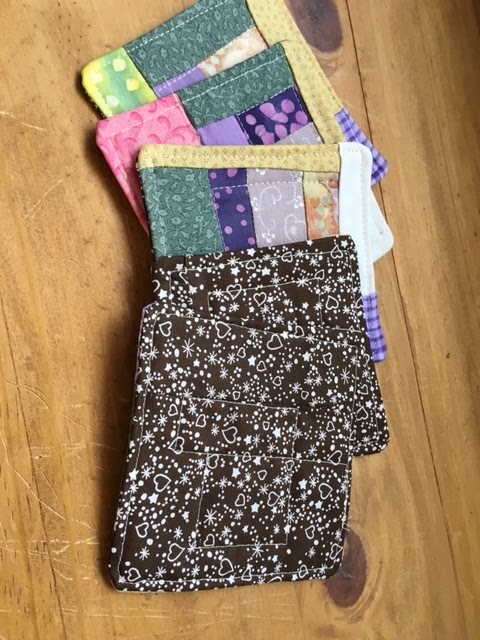
The finished coaster is about 4" square. These were a way of using up scrap fabric. They could also be made with whole 4" squares for front and back with some quilting done to them. That would actually be a great way of practicing free hand quilting.


This dresser is in front of the window and despite my putting a folded blanket on top, I see a lot of cat claw scratches in the wood. I can picture him sliding across the top as he leaps from the bed. Silly cat.

I really do like these fabric coasters though. They work really well to protect furniture from cold, sweating glasses of iced delight. They can be tossed in the washing machine if they get dirty or spilled on.

I used flannel for inside. It's got a nice weight and still wicks away the moisture. If the coasters are too thick they might wobble and make it easier for a glass to tip over.

Cut 4 1/2" squares of backing fabric and 4 1/2" squares of flannel. For the top cut 4 1/2" square of a fun fabric or piece together a fun design, trimming to 4 1/2" square. The design pictured is a log cabin style piece.

Place piece of flannel down, put pieced (or front) piece right side up (wrong side against flannel), and backing piece right side down. The two fabric pieces should be right sides together. Sew around all sides, leaving about 2-3" gap for turning. Trim corners. Turn (stick finger between two pieces of fabric to turn.) right side out. Close gap while topstitching around. Quilt as desired. With this pattern I just wander along the edges of the pieced parts.

Monday, March 2, 2020

My Biga Bread


Living in the Midwest for so many years I did not realize that there are so many foods regional to certain areas, after all, we live in the era of national brands. So I was bummed that I could no longer find my favorite artisan Portuguese bread. Or even any Portuguese style bread. So I had to learn how to make it.


This bread has a crispy crust (without need of a water reserve in oven) and a delicate, earthy, firm, and airy inside. It's the best!

It take some time with the biga forming and dough rising but hands on work is only about 10-15 minutes maximum. So I consider it an easy recipe. Since the biga takes 10-12 hours and there's 3 hours rising time plus another half hour rising time, it is not a candidate for a last minute thing.

First, you will need a stand mixer to make this dough. The dough is a bit too runny and sticky to knead by hand and it's the stickiness that makes it good bread.

After much trial and tribulation, I came up with a great bread and this recipe makes a bread that is consistent. It does turn out better in the summer than winter but if your house or apartment kitchen is a bit chilly it will still work if you set the bowl somewhere warm to rise or allow extra time for it to rise.

Proofing yeast is always a good idea. Better to give the yeast a few minutes to prove it's viable than to go through all the time and work and find out it's not. It usually starts getting bubbly within a minute or two and then you'll know it's good.

Biga
1/4 tsp yeast
1/4 c lukewarm water
3/4 c flour

The biga is a bit like sour dough starter but only needs 10-12 hours to ferment to the right product.

To make the biga, mix the ingredients the night before baking. I usually make it Friday or Saturday night before going to bed or when I think of it before bedtime, so around 9:00-9:30 at night. It can go over 12 hours if needed.

In a glass bowl, add 1/4 tsp yeast to 1/4 cup lukewarm water. Proof yeast and stir in 3/4 c flour. It will be a bit stiff, like a scone batter. Cover tightly with Saran wrap and set on the counter overnight.

For winter biga, you can use 1/2 cup lukewarm water in the biga but then account for that extra liquid in rest of process.

In the morning (or whenever 12 hours later is) when you lift the saran wrap the big should be bubbly, be more liquid than solid, and smell fermented. It reminds me of the smell of beer the most. If it has that fermented smell then it's ready to go. If it doesn't, give it a few more hours. In the nearly 100 times I've made this bread the biga only failed once. I didn't even have to smell it before knowing that it had failed because it was still almost a solid clump and it had no bubbles or fermented smell when I lifted the saran wrap.

Bread
1 tsp yeast
water
1-2 tsp salt
3 c flour

Put 1/4 c lukewarm water in mixer bowl. Add 1 tsp yeast.
At this point you can proof the yeast by giving it 3-5 minutes to see if it starts activating. If it's viable and active it will start to bubble and move around a bit. By the time I prepare the biga to add it's usually long enough to see if it's viable.
Add 1/4 c water to biga and stir fairly well. (if you did the winter version with 1/2 c it will be runny enough not to need to add more water.)
Add biga to mixer bowl with 1/2 c water and 1-2 tsp salt
Add 2 c flour
Use paddle to mix. Start at low. Once flour is worked in, continue mixing on medium for 3-4 minutes.
The dough will look elasticy, long strands visible as the paddle moves through the dough.
Now switch to dough hook and add 1 c flour. Mix another 3-5 minutes. As the hook moves the dough it will grab the flour along the sides of the bowl. Once the sides are fairly free of flour and/or dough, it's done.
Coat a large bowl with some oil. I use olive oil but vegetable oil will due in a pinch. I use a big metal mixing bowl. Transfer dough into oil lined bowl, give it a flip so both sides are coated in oil. Use the Saran wrap from biga to cover dough. Let sit for about 3 hours until dough is tripled in size.
Start oven now. 400 degrees Fahrenheit.
Sprinkle some flour on baking sheet. Shape dough into loaf shape. Set on floured baking sheet and let rise for about 30 minutes. Oven should heat for that half hour so that it's hot when dough goes in.
Score top of loaf with knife. Two or three cuts across the top are good.
Bake for 35-40 minutes.
Bread will be golden brown and sound hollow when giving it a knuckle tap.
Let cool on rack.
It's tough to resist cutting into it too soon as it smells so good but wait at least an hour. It will still be warm enough to melt butter after an hour.
I have been meaning to share this recipe here for a long time and I always missed the whole loaf photo opportunity. So, here it is with half the loaf already eaten. :) Still looks good. It was another perfect loaf.

Adorable Owl Pattern Weight, Pin Cushion, or Door Stop Pattern Creation

This little owls are so adorable and so hard working in several roles. They are awesome pattern weights. They can be used as pin cushions. They make great door stops when sized up.

Let's start with creating the pattern for the pattern weight size owls. Any other size can easily be tweaked from this basic pattern with just a ruler.

The pattern pieces are simple to design yourself. You will need a 1/4th and a 1/12th piece of a 10" circle as well as two circles, one of 3" and one of about 1 1/2". That's all there is to it!

So, 1/4th of a circle has a 90 degree. That's a right angle. The 1/12th of a circle has a 30 degree. That's a little more complicated than 90 degrees but don't worry if you don't have a protractor handy, we can get there with some easy steps.

There are a couple ways to create the 1/4th and 1/12th of a circle pieces. Let's start with the one that requires little to no math and no figuring out angles.

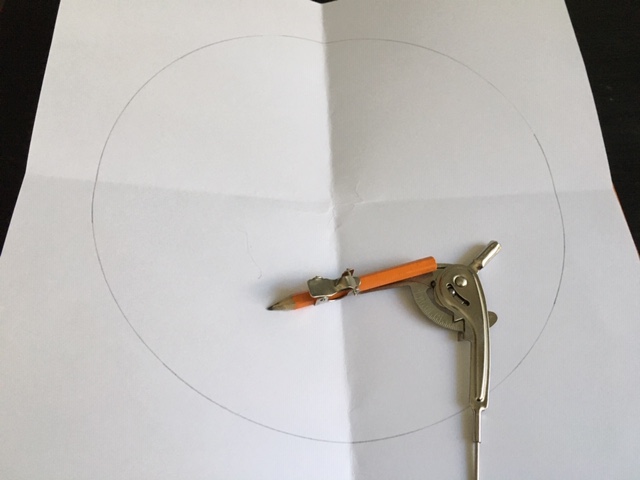
Draw a 10" circle on an at least 12" square paper or card stock. I used a compass but you can use anything that is round with a 10" diameter. There's also the fail safe of tying a pen or pencil at one end of a piece of string or yarn and using that to draw a circle. It doesn't have to be exact, just close enough.


See the fold lines? Fold the paper in half. Unfold. Fold along the other half. This will give us our center point to put our compass or string/yarn at and will also provide cutting guides.


Use the fold lines as guides and cut out 4 quarters. Set aside one of the quarters. We now have the 1/4th circle pattern piece, which will be the owl's back and sides.

Now we need the piece that will be 1/12th of the circle. If we fold 1/4 in half we will have 1/8th of a circle. Fold the 1/8th size in half and we will have 1/16th of a circle, which is a step too far, since we want 12th. So will cut that small, last fold section off and we have 1/12th of a circle.


Now cut out a 1 1/2" circle and a 3" circle. These are the pattern pieces for the cardboard and the fabric that will wrap around the cardboard for the bottom of the owl.

You now have the 4 pieces necessary to make the owl pattern weights or a small pin cushion.


Mark down the center of the two body pattern pieces to note the fabric grain.

We can tweak the pattern a bit more.

You can fold the 1/4th of a circle in half again and cut along the fold line then mark one side as fold side and cut along folded fabric. This gives you a smaller pattern piece for storage and helps keep grain straight.


This will make small owls. Aren't they adorable? And so handy!


Other options using some math: use a protractor and make the sides as long as you want with a 90 degree center for the 1st pattern piece and 30 degree center for 2nd pattern piece. Use a compass or hand draw a circular edge between the two sides. So for the back owl piece, mark 5" up on the right side from the bottom right corner of a piece of paper and 5" to the left on the bottom of that same paper and draw an arc between the two. For the front owl piece, mark 5" up on the right side from the bottom right corner of a piece of paper and 5" 30 degrees to the left. If you don't want to do the math, don't worry about it, do it the easy way with some folding to get to where you want to go.

These little guys are easy enough to super-size.

Option 1: Create bigger circles to use as base for cutting the 1/4th and 1/12th of circle. (You only have to make 1/4th of a circle pieces with longer legs instead of a whole circle to save on paper.)

Option 2: Lay finished 1/4th and 1/12th of a circle pieces on larger paper or tissue paper and use ruler to extend sides to length desired. Just be sure that the legs are the same length and that the line connecting them is an arc.